Education Q&A Structured Data: JSON-LD Guide
Want your study answer to appear directly in Google? Education Q&A structured data (QAPage) pairs a real learning question with an answer Google can surface in learning results. Add the QAPage JSON-LD, preview it with the free Structured Data Preview tool, and follow Google's Education Q&A documentation for the expected fields.
What is Education Q&A structured data?
Education Q&A markup describes a question and its answer in an educational context, so Google can show that answer directly in a learning-focused result. It is the markup behind the study-help and homework-answer results that appear when someone searches for a specific problem or concept. Instead of sending a student to a page and hoping they find the answer, Google can surface the answer itself with the question as context. That makes the result fast and useful, which is exactly what a learner wants. For the complete specification and examples, see Google's Education Q&A structured data documentation.
The underlying type is QAPage, with a Question and one or more Answer objects. What makes it education-specific is the context: the content is genuinely instructional, the question is a real learning question, and the answer actually teaches the concept rather than just restating it. Supporting fields like eduQuestionType and educationalLevel help Google place the content at the right level. If the page is a general support thread with a one-line reply, it is a forum or Q&A page, not an education answer.
This markup suits tutoring sites, homework-help platforms, textbook companion sites, and anyone publishing worked explanations of academic questions. It is a poor fit for pages that merely discuss education as a topic, like a blog post about study habits, because there is no question-and-answer pair to mark up. Google wants a real question with a real, accurate answer that a student could learn from. Quality here matters more than volume, because a wrong answer taught confidently is worse than no markup at all.
What it looks like in search results
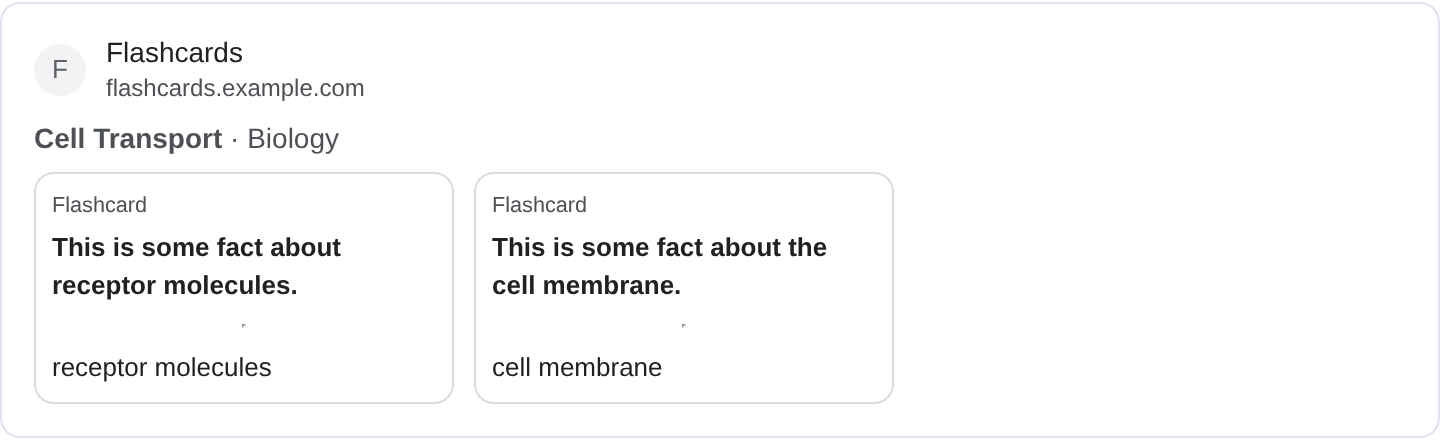
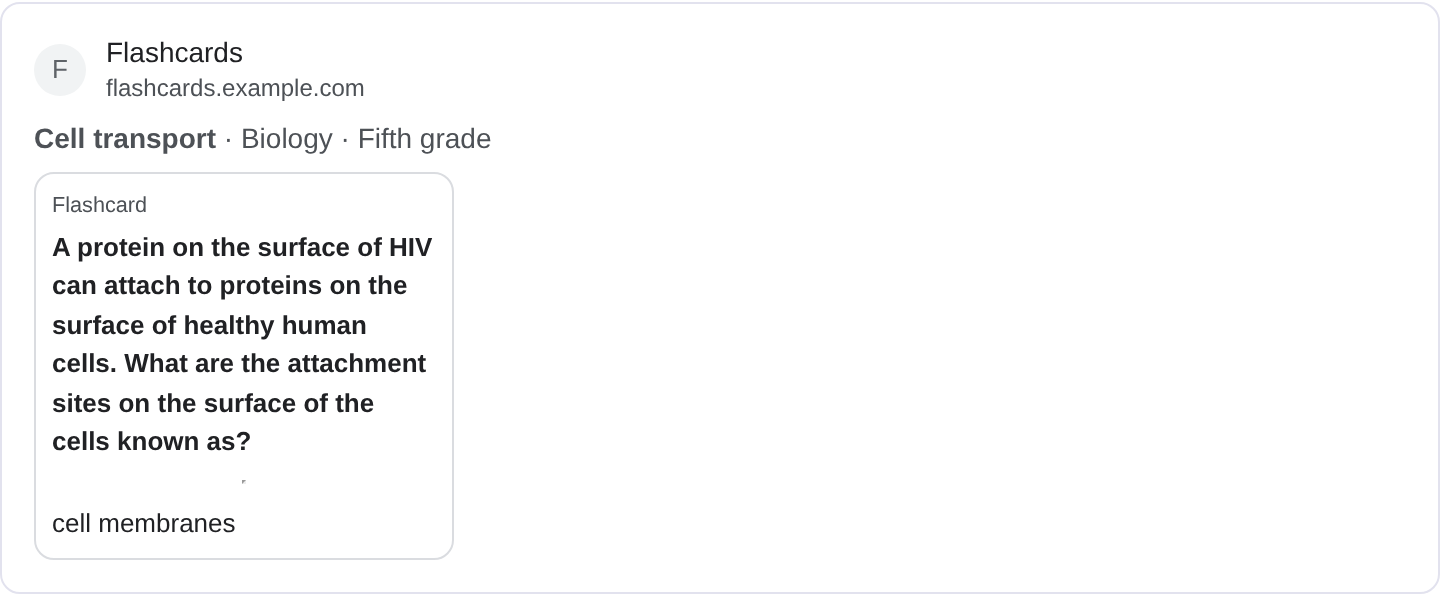
A marked-up education answer can appear as an enriched result that shows the question and a chunk of the answer, sometimes with a label indicating it is a learning resource. The exact layout shifts with Google's tests and the query, so the real appearance may differ from any example you have seen. Check your own page in the Rich Results Test and preview the structure with the Structured Data Preview tool.
JSON-LD example
{
  "@context": "https://schema.org",
  "@type": "QAPage",
  "mainEntity": {
    "@type": "Question",
    "name": "How do I solve 2x + 7 = 15?",
    "text": "How do I solve 2x + 7 = 15?",
    "eduQuestionType": "equations",
    "answerCount": 1,
    "suggestedAnswer": {
      "@type": "Answer",
      "text": "Subtract 7 from both sides to get 2x = 8, then divide by 2 to get x = 4.",
      "upvoteCount": 12,
      "author": {
        "@type": "Person",
        "name": "Priya N."
      }
    }
  }
}
mainEntity is the Question, with name and text carrying the actual question. eduQuestionType describes the kind of problem, which helps Google route it to the right learner. suggestedAnswer holds the answer text, and upvoteCount gives a signal of whether other users found it helpful. author credits the person who wrote the answer, which supports trust. Keep the answer genuinely explanatory: a bare final answer with no reasoning is less useful than a short worked solution.
Required and recommended properties
Google needs a Question with a name and an Answer with text. Without both, there is no Q&A to show. The question text should be a real question someone would ask, and the answer should actually address it. For education results, accuracy is the hard requirement; a confident wrong answer can hurt the site's credibility far more than missing markup would.
Recommended: answerCount to show how many answers exist, upvoteCount on the answer as a helpfulness signal, author for the answer writer, and eduQuestionType to signal the subject area. If you have several answers, include the ones that are genuinely useful rather than every reply. Consistent authorship and dates make the page look maintained, which matters for a subject where answers can go out of date.
How to add Education Q&A markup to your page
1) Open the validator and choose the QAPage type. 2) Fill in the question, then add the answer text, author and upvote count. 3) Fix any errors the preview flags, most often a missing answer or a malformed author. 4) Paste the JSON-LD into the question page <head>. 5) Test the live URL in the Rich Results Test and confirm Google detects the QAPage with a valid answer.
Common mistakes to avoid
Answering a question that is not really asked. If the page's question is invented to match an answer, Google can usually tell. Start from real questions learners search for.
Bare answers with no explanation. "x = 4" teaches nothing. Show the steps so the answer is genuinely educational.
Wrong or unverified answers. A confident mistake in a learning result is damaging. Have someone check the math or the facts before publishing.
Using QAPage for a discussion thread. A forum conversation is DiscussionForumPosting; use QAPage only when there is a question with a clear answer.
Upvote counts that are fabricated. Inflated helpfulness numbers are easy to spot and undermine trust.
Question text that is a keyword string. "math help solve equation homework" is not a question. Write it the way a student would.
Not dating the answer. For subjects that change, an undated answer looks stale. Add a visible date.
Copying answers from other sites. Duplicated content with markup does not help and can look like scraping.
Frequently asked questions
Is this the same as a regular Q&A page? It uses the same QAPage type, but education results apply when the content is genuinely instructional and Google decides to show the learning treatment.
Do I need one page per question? Yes, one clear question page with its answer is the cleanest approach. A page with twenty unrelated questions is hard to mark up well.
Can I use upvotes from a plugin? Yes, as long as the counts are real. Use the actual numbers your platform records.
Does it help ranking? It can make your answer surface directly, which improves visibility for question queries. It is not a direct ranking factor.
Related guides
Try it on your own content
The Structured Data Preview checks content against these practices in seconds. Free and no sign-up; see the tool page for how analysis works.