What is Generative Engine Optimization (GEO)?
Generative Engine Optimization (GEO) is the practice of shaping your content so that AI-powered search engines can understand it, trust it and cite it when they write an answer. Instead of returning ten blue links, tools such as ChatGPT Search, Perplexity, Google's AI Overviews and Gemini read many pages, pull out the passages that answer a question and combine them into one response. GEO is about being one of the sources that response is built from.
For a longer, plain-language walkthrough of the idea, including how AI systems build answers and what GEO is not, see our What is GEO? guide.
The term was popularised by a 2023 research paper from academics at Princeton, Georgia Tech, the Allen Institute for AI and IIT Delhi, which tested ways of changing web content to raise its visibility in generative answers. The authors reported that adding relevant statistics, quotations from credible people and clear citations tended to help, while keyword stuffing did little.
In practice, GEO rewards the same qualities that make content useful to people: a direct answer near the top, a clear structure, specific facts, named sources and enough depth to be worth quoting. A generative engine does not rank a page the way a classic search engine does. It retrieves passages, judges whether they answer the question and decides which ones to quote. Content that is easy to lift out and attribute has a better chance of being used.
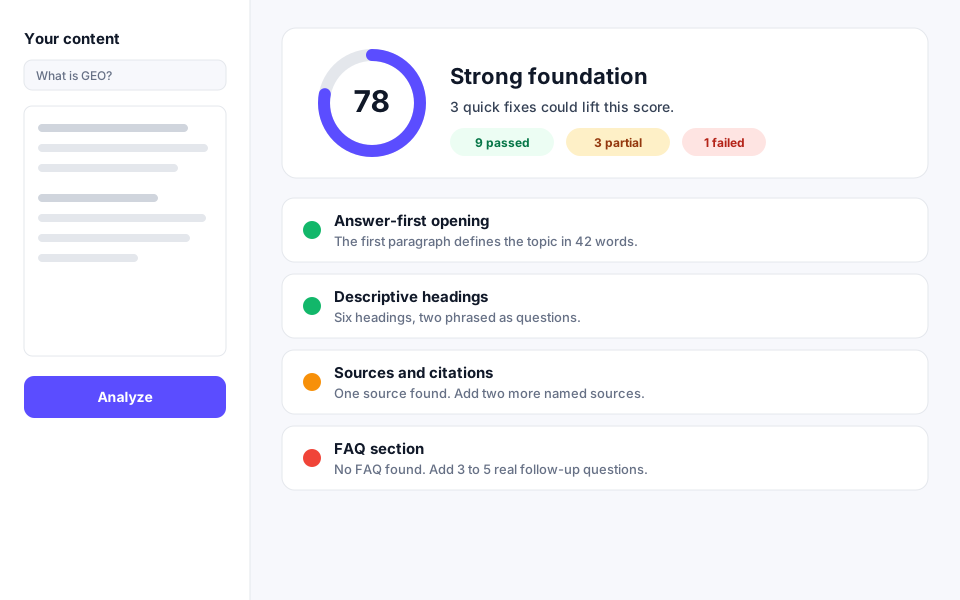
The GEO Optimizer turns those ideas into a checklist you can run on any draft in a few seconds, so you can see what to fix before you publish.
What the GEO Optimizer checks
The app reads the text you paste in and scores it against 13 checks, grouped into four areas.
- Answerability. Does the opening paragraph state the answer or definition in roughly 20 to 70 words, and does it use the same terms as the question you want to answer?
- Structure. Are there enough descriptive headings, are some phrased as questions, and are lists or tables used where they fit? Are paragraphs short enough to be quoted on their own?
- Evidence. Does the content include specific numbers, named sources, links and attributed quotations instead of general claims?
- Coverage and freshness. Is the piece long enough to cover the topic, does it include an FAQ, does it name the people, products and organizations readers expect, and does it show when it was last updated?
Each check returns a pass, partial or fail result with a short explanation and a suggested fix, so you always know why a score is what it is.
How to use the GEO Optimizer
- Open the app. It works on desktop and mobile and needs no account.
- Paste your draft into the content box. Plain text, Markdown and simple HTML all work.
- Optionally, type the question or search phrase you want the page to answer. This enables the query-focus check.
- Choose the content type, so length expectations suit an article, a product page or an FAQ.
- Select Analyze. You get a score from 0 to 100, the three highest-impact fixes and the full check list.
- Edit your draft, paste it again and compare the score. Repeat until the high-impact items are cleared.
How the score works
The score is a transparent checklist, not a prediction. Each check carries a fixed number of points, and the final score is the points earned divided by the points available, scaled to 100. If you leave out the target question, the query-focus check is skipped and the score is rescaled.
The checks come from widely recommended practices for writing content that machines can parse and quote, along with the findings of published GEO research. They are heuristics. No tool can see inside ChatGPT, Perplexity or Gemini, and none can promise that your page will be cited. Use the score to find weak spots in a draft, not as a guarantee. A page that scores 90 can still go uncited if another source is more authoritative, and a page that scores 60 can be cited if it is the best answer available.
GEO versus traditional SEO
Traditional SEO aims to rank a page in a list of results, using signals such as links, keyword relevance and page experience. GEO aims to get a passage from your page selected and attributed inside a generated answer. The two overlap heavily: clear writing, accurate facts and a well-organized page help in both. Where they differ is the unit of competition. In classic search it is the whole page. In generative search it is often a single paragraph, list or table.
Our guide on GEO vs SEO explains what changes, what stays the same and how to split your effort. If you want hands-on writing advice, read how to structure content so AI search engines can cite it.
Who the GEO Optimizer is for
- Content creators and bloggers who want their articles to be quoted, not just ranked.
- SEO agencies and consultants who need a quick, explainable audit to share with clients.
- In-house marketers who review drafts from several writers and want a consistent standard.
- Founders and documentation teams who want product pages and help articles to appear in AI answers.
Privacy
The analysis runs in your browser. The text you paste is not uploaded to WizeTool and is not stored once you close the page. Read the full Privacy Policy for details on what the site does collect.
FAQ
What is a GEO Optimizer?
A GEO Optimizer is a tool that checks whether your content follows the practices that make it easier for generative AI search engines to understand and cite. The WizeTool version scores a draft against 13 transparent checks and explains each result.
Is the GEO Optimizer really free?
Yes. It is free to use, needs no account and has no usage cap. WizeTool is funded by ads on its guides and landing pages, not by charging for the tools.
Will this make ChatGPT or Perplexity cite my page?
No tool can guarantee that. AI search engines choose sources using many signals that nobody outside those companies can see. The optimizer helps you remove avoidable weaknesses, such as buried answers, vague claims and missing sources, which improves your chances without promising an outcome.
Does the tool store my content?
No. The analysis runs locally in your browser, and the text you paste is not sent to our servers.
How is GEO different from SEO?
SEO focuses on ranking pages in search results. GEO focuses on having your content selected and cited inside AI-generated answers. They share many best practices, but GEO puts more weight on direct answers, self-contained passages and verifiable facts.
Which AI search engines does it cover?
The checks are engine-neutral. They reflect practices that apply to ChatGPT Search, Perplexity, Google's AI Overviews, Gemini, Microsoft Copilot and similar systems, rather than rules for any one product.
Ready to check your content?
Open the app, paste your draft and get your score in seconds.