 Om Usturge
What Is WizeTool, and How Does It Work?
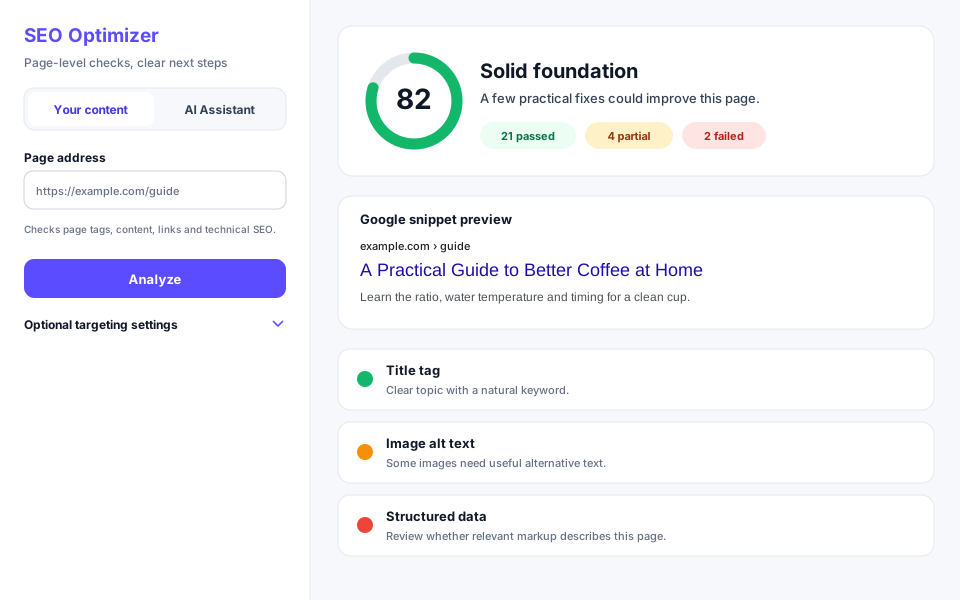
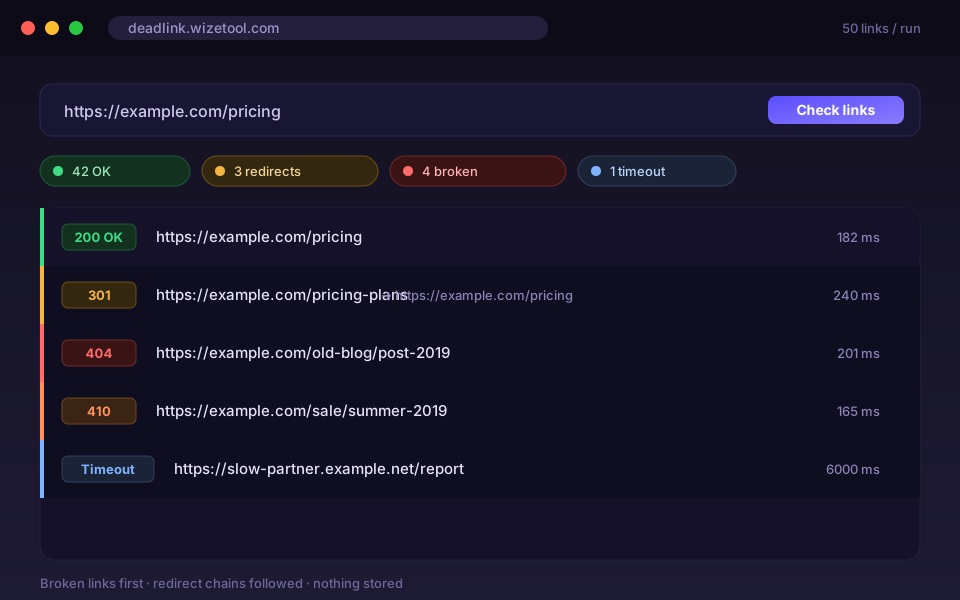
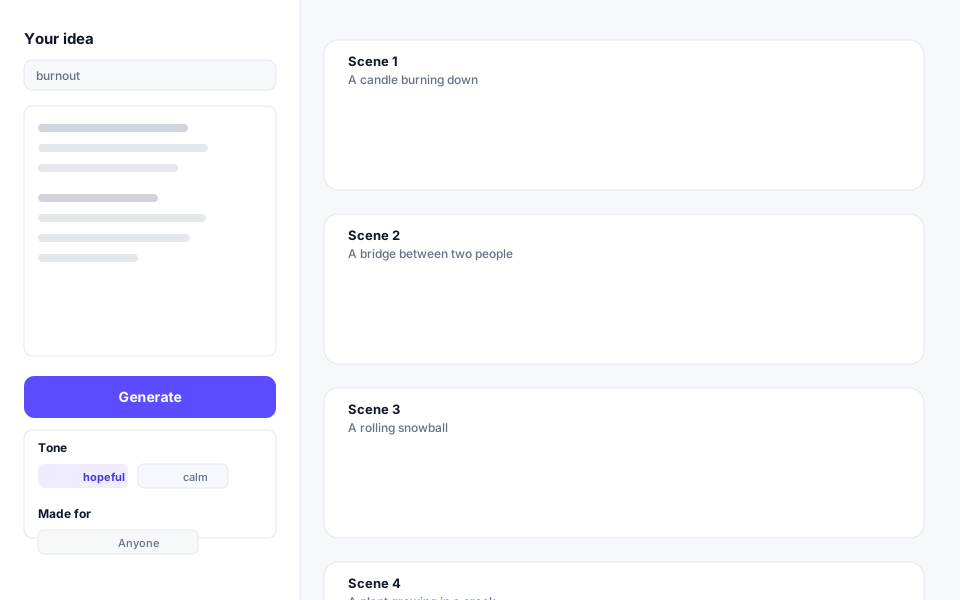
WizeTool is a free set of no-sign-up utilities for improving how people find and understand web content. The SEO Optimizer reviews a public page or a pasted draft for common on-page and technical issues. The GEO Optimizer checks content structure and signals that matter for AI search. The Dead Link Checker finds broken links, redirects and timeouts. The Visual Metaphor Generator turns an abstract idea into four drawn scenes. Each tool explains its checks and limits. None can guarantee search rankings or citations.
How Long Does It Take to Get Started?
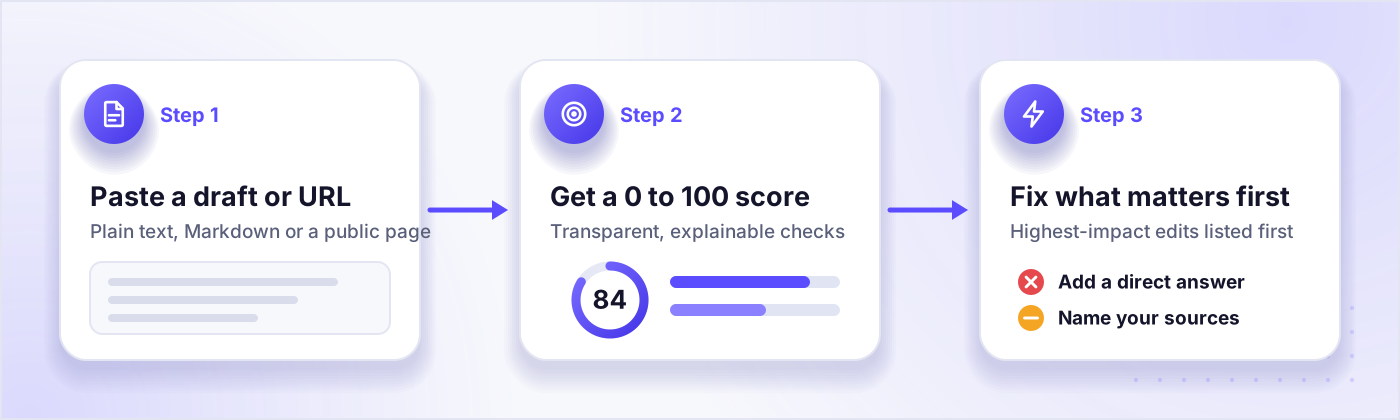
Start in seconds: analyze a public URL or paste a draft into the SEO Optimizer, or paste content into the GEO Optimizer. Both return a score and prioritized findings without an account.
What Tools Are Available?
Each WizeTool app does one job well and needs no account. Pasted drafts are checked in your browser; SEO URL checks fetch the public page for analysis:
- SEO Optimizer (Live) Checks a public page or a pasted draft for common on-page and technical SEO issues, previews a search snippet and ranks the fixes.
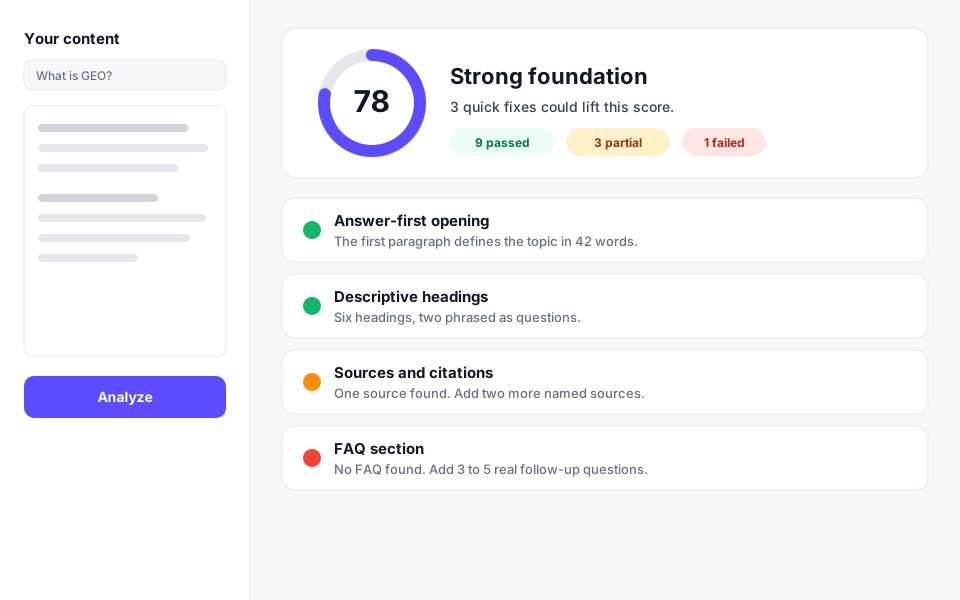
- GEO Optimizer (Live) Scores content from 0 to 100 for AI search readiness and lists fixes in plain language.
- Dead Link Checker (Live) Finds broken links, redirects and timeouts on a page or in a list of URLs.
- Visual Metaphor Generator (Live) Turns an abstract idea into four drawn scenes from 27 shapes, with palettes and SVG or PNG download.
More tools are planned. Suggest one at hello@wizetool.com.
What Does the GEO Optimizer Check?
The GEO Optimizer runs 13 transparent checks. Research on what actually drives AI citation shows that evidence structure matters more than surface formatting. A 2026 study analyzing 602 prompts and 21,143 citations across ChatGPT, Google AI Overview, and Perplexity found that pages containing numbers or statistics showed +61.6% higher citation influence, while pages with definitions showed +57.3% higher influence — and Q&A formatting alone produced no measurable lift (arXiv:2604.25707). Here are the five checks with the biggest impact on citation likelihood:
- Crawler access — Can AI bots reach your page? A separate study of 252,000 citation trials across six LLMs found that crawler access is one of four unanimous "gatekeeper" factors — fail it and no other content strength can compensate (ACM, "What Gets Cited," 2026).
- Answer-first structure — Does the page lead with the answer people are searching for? The same ACM study found topical relevance is the strongest differentiator once gatekeepers are met.
- Schema markup — Is structured data present, valid, and matching the content? Structured evidence blocks concentrate citation credit: a causal audit of 129 agentic search transcripts found structured rendering raised citation count by +0.50 citations per answer (arXiv:2609.15164).
- Originality — Is the content unique, or does it duplicate another page? A 2026 analysis of 53,090 citation URLs found that AI engines hallucinate 3–13% of citations, so independently verifiable, non-duplicated claims are structurally advantaged as verification infrastructure improves (Machine Relations Research, 2026).
- Source backing — Are key claims supported by named sources and links? A cross-platform arXiv GEO study found that adding inline citations to named primary sources is the single most effective individual optimization for AI visibility, outperforming statistics (+37%), expert quotes (+22%), and keyword stuffing (+3%) (BetterAISearch, citing arXiv research).
The remaining eight checks cover headings, lists, tables, freshness signals, author attribution, and more. Every check has a plain-language explanation published on the tool page, so the score is something you can verify and act on — not a black box. One caution from the research: a recent timestamp is a unanimous gatekeeper across all six LLMs studied, so freshness signals are treated as a prerequisite, not a nice-to-have.
Is WizeTool Really Free?
Yes. Every live tool is free, with no account, no paywall, and no trial period. The tool workspaces themselves carry almost no advertising, so they stay fast and easy to use.
How Is WizeTool Funded?
WizeTool shows Google ads on its guides and tool landing pages. Those ads fund the tools. The workspaces are kept ad-light on purpose so the experience stays focused. Publishers using AdSense must comply with the AdSense Program policies, which require that ads not interfere with content or mislead users about which parts are editorial.
Do You Store What I Analyze?
Pasted-content checks run in your browser. SEO URL analysis fetches the public page from our server to inspect it. If an AI feature is available and you choose to use it, your question and relevant analysis context may be sent to its configured provider. WizeTool does not store the page, excerpt or conversation. See our Privacy Policy for the details.
What Should I Read Next?
Start with these practical guides for on-page SEO, Search Console and AI search:
- On-Page SEO Checklist: 12 Practical Checks — A page-by-page review of content, snippets, links, accessibility and technical access.
- How to Check On-Page SEO Manually in 10 Minutes — A fast, repeatable manual check you can run on any page before publishing.
- How to Use an SEO Optimizer to Check On-Page SEO — What an SEO optimizer checks, how to read the score, and which fixes to prioritize.
- How to Use Google Search Console to Find SEO Opportunities — Read query and page performance in context and choose evidence-led next steps.
- How to Read the Search Console Pages Report — What indexed and not indexed mean, and which actions actually help.
- How to Fix Duplicate URLs and Canonical Issues — Find duplicates, choose one canonical, and consolidate with redirects.
- How to Find and Fix Broken Links — Crawl, prioritize, and fix broken links and redirect chains.
- 301 vs 302 Redirects Explained — When to use each and how they affect SEO.
- XML Sitemaps: What They Do and Do Not Do — What sitemaps help with and what they cannot fix.
- GEO vs SEO: What Changes and What Stays the Same — How GEO and SEO share a foundation but compete for different things.
Prefer primary documentation over our own guides? The resources library collects the official search documentation we link to, and you can install WizeTool as an app if you use it on a phone or tablet.