Query Fan-Out Explained: How AI Search Breaks Up a Question
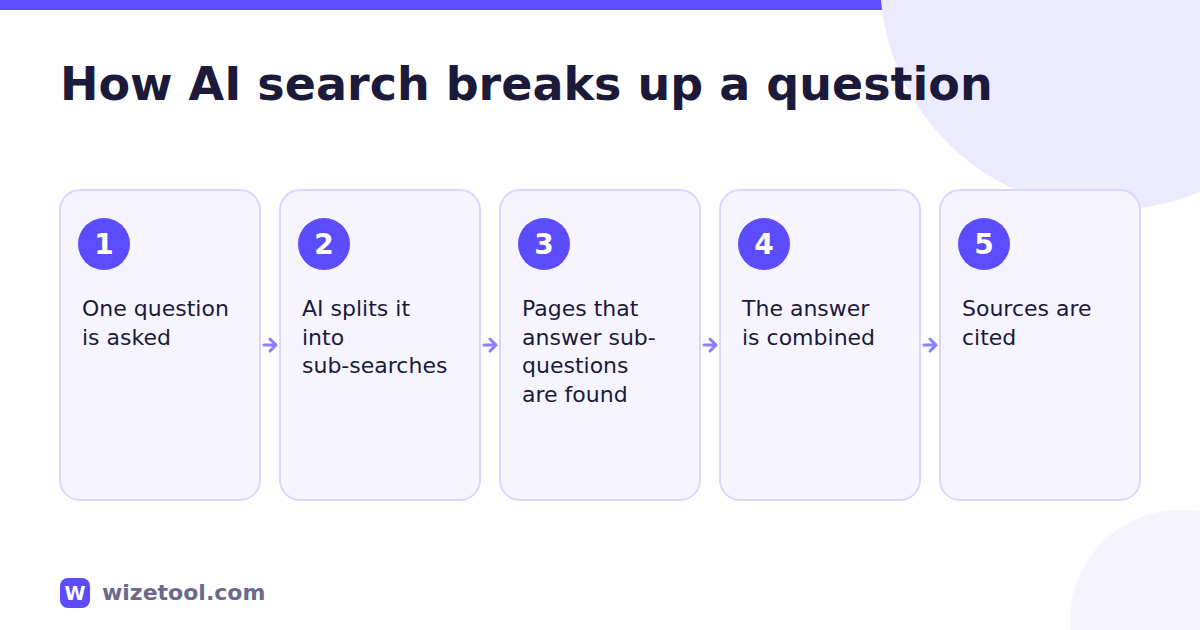
Short answer: Query fan-out is when an AI search system takes one question and splits it into several related searches, then combines what it finds into one answer. For you, it means a page can be used because it answers a sub-question, even if it never ranked for the main phrase.
Google has described using a "query fan-out" technique in its AI search experiences. Other AI search tools work in similar ways, though details differ and aren't fully public. Treat the ideas below as a practical model, not an official recipe.
A simple example
Someone asks: "How do I make my new website show up in Google?" A system might break that into searches like:
- how long does it take for a new site to be indexed
- how to submit a sitemap to Google Search Console
- why isn't my new site showing in Google
- on-page SEO basics for new websites
- how to get backlinks to a new site
The answer then pulls from pages that answer those smaller questions well.
Why this matters for content
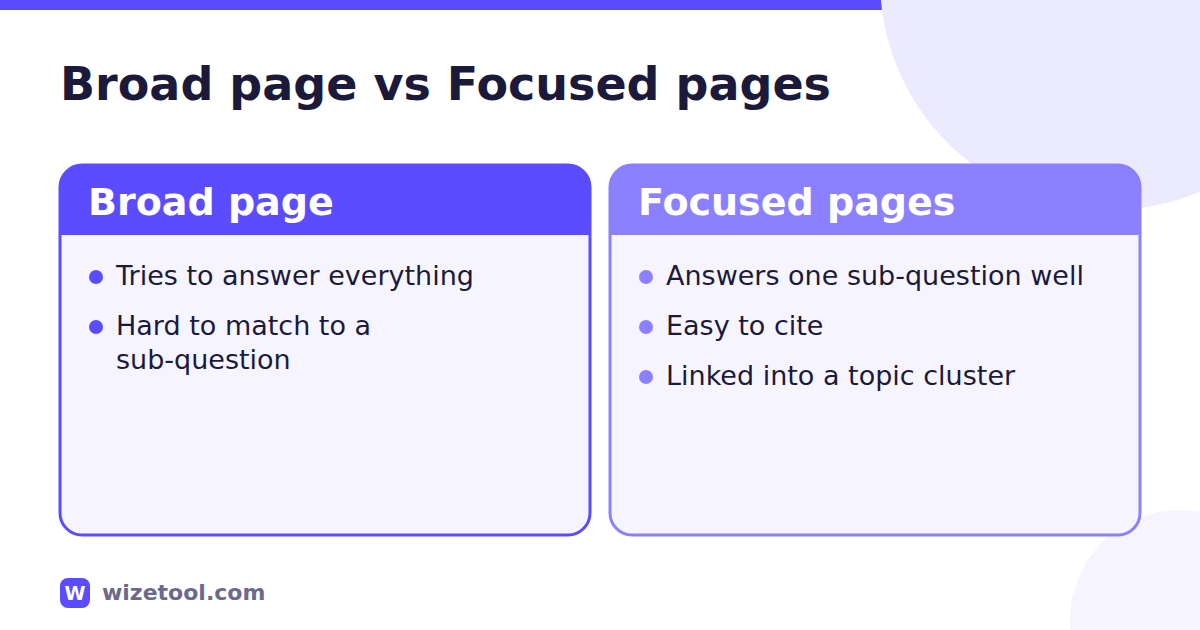
- Broad pages lose to specific ones. A page that answers one sub-question clearly can be cited even if it's small.
- Topic coverage helps. A set of linked guides covers more sub-questions than one long page.
- Clear headings matter. A question-style heading is easy to match to a sub-question.
How to map the fan-out for your topic
- Write the main question in plain words.
- List 8 to 12 follow-up questions someone would ask next. Use Search Console queries, "People also ask", and your own support emails.
- Group them: definitions, how-tos, comparisons, problems, tools.
- Check which ones you already answer. Note which page.
- Write the missing ones, and link them together.
Worked example: "on-page SEO"
This is the real query fan-out behind wizetool.com's on-page SEO content. The queries below come from our own Search Console data — the sub-questions people actually ask, with the average position each one reaches.
| Sub-question (real query) | Impressions | Avg position | Our page |
|---|---|---|---|
| What is on-page SEO? | — | — | On-page SEO checklist |
| How do I check it in 10 minutes? | — | — | Manual check |
| What should a new site do first? | — | — | Checklist for new websites (guide coming soon) |
| How long should a title be? | — | — | Titles and descriptions (guide coming soon) |
| Which tool can check my page? | 360 | 42.7 | SEO Optimizer |
| How to check on page SEO | 145 | 76.8 | Manual check |
| SEO optimizer tool | 125 | 53.1 | SEO Optimizer |
| SEO optimization tool online | 119 | 83.0 | SEO Optimizer |
| Check onpage | 89 | 66.2 | Manual check |
| SEO optimizer online | 87 | 71.6 | SEO Optimizer |
| SEO page optimization tool | 64 | 84.9 | SEO Optimizer |
| On-page SEO checklist | 42 | 88.7 | On-page SEO checklist |
| On page SEO checklist | 40 | 89.4 | On-page SEO checklist |
| Onpage SEO check | 35 | 83.5 | Manual check |
| On page SEO check | 26 | 89.1 | Manual check |
Two things stand out. First, the "SEO Optimizer" cluster (the tool queries) carries the most impressions, but most of those queries sit at position 42 to 90 — well past the first page. Second, the phrasing varies wildly: "check onpage", "onpage SEO check", "on page SEO check" are three different spellings of the same question, and each one is a separate search. That is the fan-out in practice: one intent, many wordings.
That table is also a content plan and an internal link map.
What not to over-read
- Nobody outside the search companies knows the exact sub-queries.
- You can't "optimise for fan-out" with a trick. Cover the topic well.
- Don't create dozens of thin pages, one per possible sub-question. Combine closely related ones.
Quick checklist
- Main question written
- 8 to 12 sub-questions listed from real data
- Each mapped to a page, or marked missing
- Missing ones scheduled
- Pages linked to each other
FAQ
Is fan-out the same as keyword research? Related, but it works at the level of questions and tasks rather than single keywords.
Does it replace SEO? No. Pages still need to be crawlable and useful. See GEO vs SEO.
Where can I see it happening? Some AI tools show the searches they ran. Look for that in the interface.
Related guides
- What is GEO?
- GEO vs SEO
- How to structure content for AI search
- FAQ sections AI engines can use (guide coming soon)
Sources
- Google: Expanding AI Overviews and introducing AI Mode — the post that first describes the "query fan-out" technique (March 2025).
- Google: AI Features and Your Website — how AI Overviews and AI Mode use fan-out, and how they count in Search Console.
- wizetool.com Search Console query export, on-page-check cluster — the real sub-queries behind the worked example in this guide.